

To check if a title is branded, read the paper title for brand wording, find the VIN, and run a national NMVTIS history check. Then compare the two. A branded title, such as salvage, rebuilt or junk, marks a car or motorcycle that was damaged, written off or flagged in another way, and a buyer should know that before paying.
Table of Contents
Key takeaways
- To check if a title is branded, read the paper title, match the VIN, run an NMVTIS check, and get an independent inspection.
- Find the VIN on the windshield or door pillar of a car, or on the frame of a motorcycle, and confirm it matches the title.
- Buy an NMVTIS report from an approved provider before you travel; the NMVTIS site says to expect to pay up to $4 per report.
- Read the paper title for printed brand labels such as salvage, rebuilt or junk, using your state’s rules.
- Get an independent inspection by a qualified mechanic, because history reports do not record every damage event.
How to check a title in five steps
- See the paper title. Ask the seller to show it and confirm the seller’s name is on it.
- Find the VIN. Match the number on the vehicle to the number on the title.
- Run an NMVTIS check. This is the official US vehicle history database.
- Compare the results. Look for any brand, odometer problem or damage record that does not match what the seller says.
- Get an independent inspection. A history report is one input, not a full check of the machine.
Each step catches different problems. Skipping one leaves a gap, so do all five before you hand over money.
Find the VIN on a car or motorcycle
On most cars, the vehicle identification number (VIN) is on a plate at the base of the windshield on the driver’s side, and on a label on the driver’s door or door pillar. It also appears on the title and the registration. You need it to run any title check, so find it before you meet the seller.
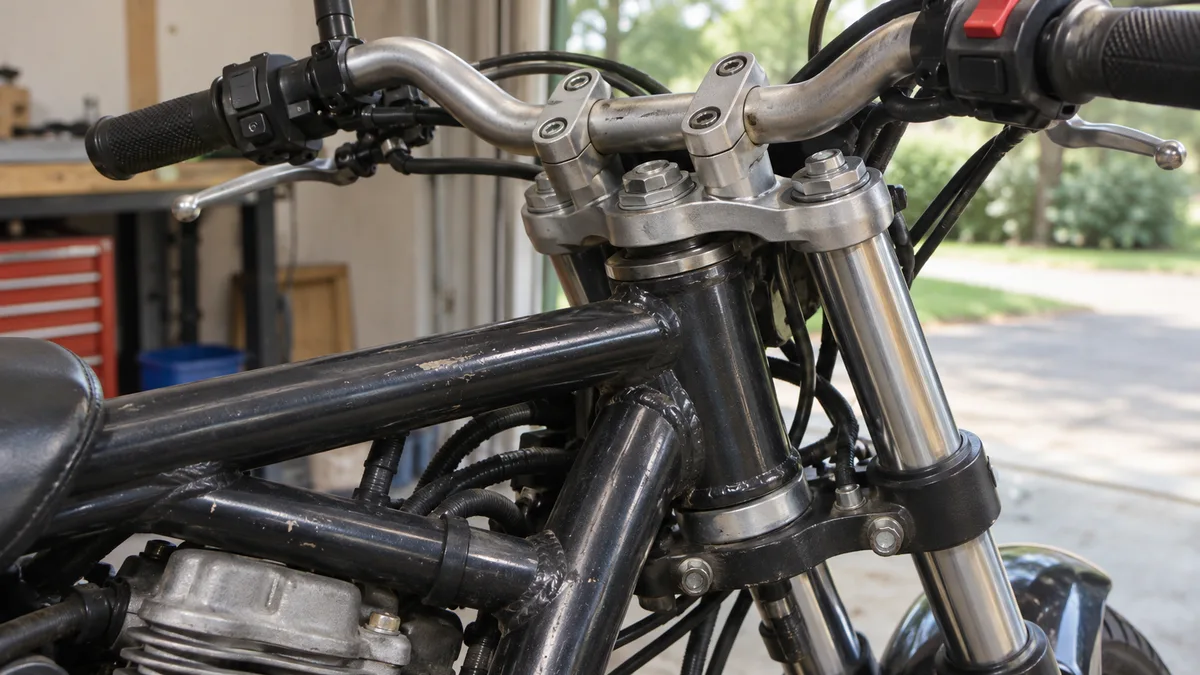
On a motorcycle, the stamped VIN is usually on the frame near the steering head. On recent Harley-Davidson models it is on the right side of the frame close to the steering head. Older models put it on the right frame backbone just behind the steering head. Other makes differ, and older classics may use a different number format, so check the owner’s manual for your exact model.
Photograph the full number before you run a lookup. If the number on the frame does not match the paperwork, treat that as a serious warning sign.
Run an NMVTIS check
To run an NMVTIS check, buy a report from one of the approved data providers listed at vehiclehistory.bja.ojp.gov and enter the VIN. The National Motor Vehicle Title Information System (NMVTIS) is a national database designed to protect consumers from fraud and unsafe vehicles.
The government describes these reports as offering accurate information about a vehicle’s title, odometer data and certain damage history. The word “certain” matters. The report is not a promise that every damage event is recorded. The NMVTIS buying tips page says to expect to pay up to $4 per report; check the current price on the provider’s site before you order.
Use the report as a starting point. If the seller’s story and the report disagree, stop and ask why before you go further.
Run the check before you travel to see the vehicle. A bad report then costs you a text message instead of a trip. Your state motor vehicle agency may also offer its own title lookup, so check its website for what it asks for.
What commercial history reports add
Commercial history reports add records the basic government check may not show, such as accident records, service history and the number of owners. That detail helps you see how a car was used over time.
A clean report is not proof that a vehicle is clean. NMVTIS itself says its data is not complete, so a clean report does not rule out problems, and it recommends checking the title record with the state as well. Use a commercial report to add detail, then rely on the paper title and an inspection to confirm.
Read the paper title itself
On the paper title, look for printed brand wording, then check where your state prints it, because wording and layout differ by state.
In California, a brand appears in a red box labeled VEHICLE HISTORY near the upper right corner of the title. The brand “Salvaged” tells you the car was involved in an accident or other major damage. In New York, an owner certifies damage by marking a box on the back of the title, and a title the DMV issues for a rebuilt salvage vehicle 8 model years old or newer displays “REBUILT SALVAGE: NY.”
Common brands include the following:
- Salvage: a vehicle insurers declared a total loss. It is not road legal until it is repaired, passes the state’s inspection and is retitled as rebuilt.
- Rebuilt: a salvage vehicle that was repaired and passed the state’s inspection. Inspections differ by state, so the brand does not prove the repair was done well.
- Junk: a vehicle that can only be used for parts or scrap and is not to be repaired for road use.
- Lemon law buyback: a vehicle the manufacturer repurchased under state lemon law.
A brand does not always mean the vehicle is dangerous. California’s DMV notes that many salvage vehicles are expertly repaired, but some are not properly repaired or tested and may be dangerous to operate. A rebuilt frame is worth a physical inspection by a qualified mechanic.
Red flags such as title washing
Title washing, or brand washing, means getting a title that no longer shows a brand. NMVTIS says it can happen when a vehicle is retitled in another state that does not check with the state that branded it. It can hide a salvage, flood, rebuilt or junk history and make the car look clean.
Watch for these warning signs:
- A title from a state the seller has no link to, especially if the car recently moved.
- A VIN on the vehicle that does not match the title.
- A missing title, or a seller who cannot show ownership documents.
- A salvage or rebuilt history with no inspection paperwork.
- A seller who will not let you run a check or take the car to a mechanic.
A brand cannot legally be wiped back to a clean title: passing a state inspection can turn a salvage title into a rebuilt title, but the title stays branded. NMVTIS is designed to help states deter title fraud, yet washing can still happen where a state does not check, so a title that looks clean is not proof on its own. If a seller offers to clear a brand for you, walk away.
A branded title can also limit the coverage you can buy for that car, and a crash on your own record changes your premium too, so read about how a vehicle accident can affect your auto insurance before you commit.
Questions buyers ask
Is a clean title enough to trust a seller?
No. A clean title is one signal. Some damage never leads to a brand, and the NMVTIS report covers only certain damage history. Combine the title, the report and an independent inspection.
Does a branded title mean the vehicle is unsafe?
Not always. A rebuilt vehicle that has passed inspection can be a reasonable buy at the right price. Still, check the repair, ask for the paperwork and have a mechanic look at structural repairs.
Is a motorcycle checked in the same way?
Yes. The steps are the same, but the VIN is on the frame, so start there. Once the title checks out, compare motorcycle insurance tips to save money before you ride away.
What should I do if the check finds a brand?
Stop and ask the seller to explain it, with repair records and inspection paperwork. Then decide whether the price still makes sense after an independent inspection. If you are rethinking the purchase as a whole, read about whether it is a good time to buy a used car right now.